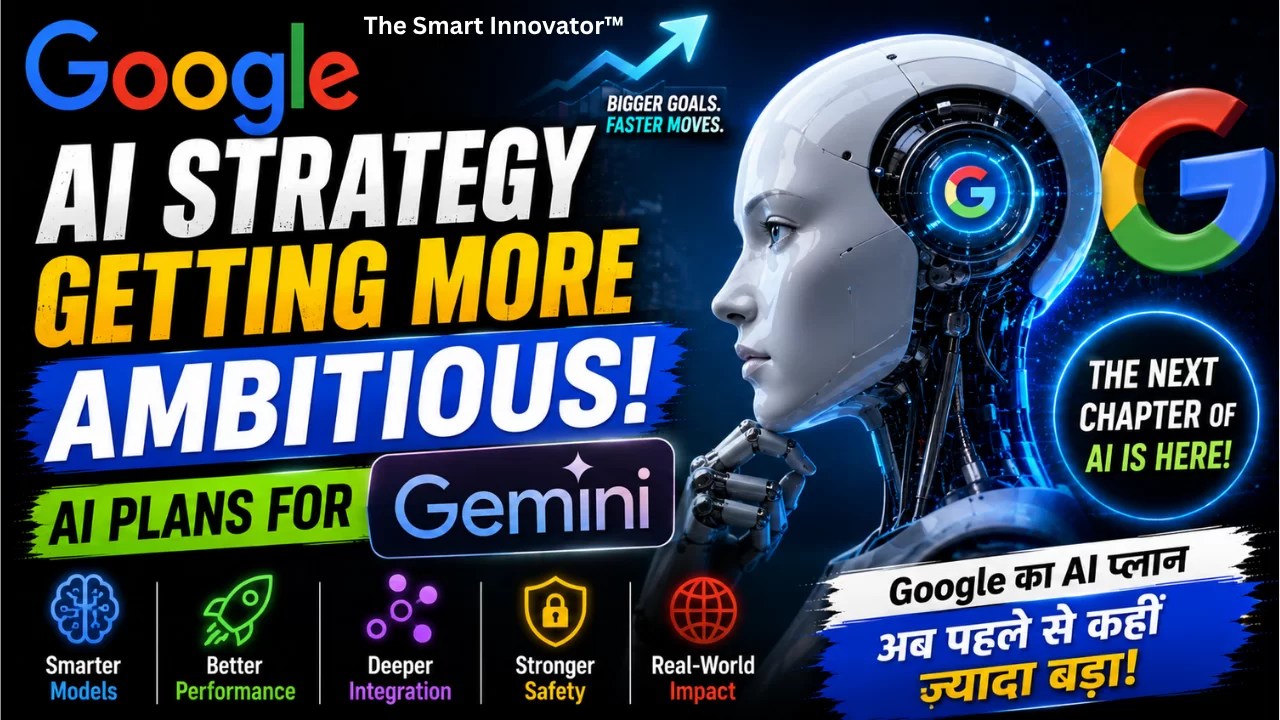
When Google introduced Gemini, many people assumed it was simply the company’s answer to ChatGPT. That assumption no longer reflects reality. Today, Google AI strategy extends far beyond a single chatbot or language model.
At Google I/O 2026 and subsequent product updates, the company made one thing clear: Gemini is becoming the intelligence layer that powers nearly every Google product, from Search and Android to Workspace, Chrome, Cloud, YouTube, and even software development.
If our earlier article, “Gemini 4 Explained: What Google Revealed About Its Next AI Model,” focused on the evolution of Gemini itself, this story looks at the bigger picture—why Google’s overall AI strategy is accelerating faster than ever and how it differs from rivals such as OpenAI and Microsoft. Google says its latest announcements are centered on an “agentic era,” where AI doesn’t just answer questions but actively helps users complete tasks across products.
Unlike companies focused primarily on standalone AI assistants, Google is embedding artificial intelligence across its entire ecosystem.
That includes:
The strategy is simple: instead of asking users to visit AI, Google wants AI to appear wherever users already spend their time.
Rather than treating Gemini as a chatbot, Google increasingly positions it as the intelligence engine behind its services.
Recent updates have expanded Gemini’s role with:
Google’s announcements increasingly describe Gemini as an “agent” capable of completing multi-step tasks instead of only generating text.
One noticeable change over the past year is Google’s release cadence.
Instead of waiting for a single annual event, Google now introduces AI capabilities throughout the year across consumer and enterprise products.
Recent examples include:
This faster rollout reflects Google’s effort to respond more quickly to a highly competitive AI market.
Unlike most AI companies, Google already serves billions of Search queries every day.
Instead of building a new destination, Google is bringing AI directly into Search through features such as AI Mode and richer AI-generated responses.
That gives Google two major advantages:
For Google, improving Search with AI isn’t just about innovation—it’s also about protecting its core business while creating new ways for users to discover information.
Google’s smartphone strategy is evolving just as quickly.
Gemini is replacing many traditional Assistant functions and becoming deeply integrated into Android.
Users can now expect AI features such as:
Because Android powers billions of devices worldwide, every Gemini improvement has the potential to reach an enormous audience.
Perhaps the biggest strategic shift is Google’s focus on agentic AI.
Instead of simply responding to prompts, Google’s newer AI systems are increasingly designed to:
This approach moves Gemini closer to becoming a digital assistant capable of handling real-world workflows.
Enterprise customers remain a major priority.
Google Cloud continues expanding AI capabilities for businesses through:
For Google, business AI may become just as important as consumer-facing products over the coming years.
Google isn’t relying exclusively on proprietary AI.
The company continues investing in the Gemma family of open models, giving developers access to lightweight AI systems for research and application development.
This allows Google to compete in both proprietary and open AI ecosystems simultaneously.
| OpenAI | |
|---|---|
| AI integrated across products | ChatGPT-first ecosystem |
| Search + Android + Workspace | ChatGPT + APIs |
| Large consumer ecosystem | Strong developer ecosystem |
| Multiple AI models and services | Focus on frontier language models |
| Billions of existing users | Rapid standalone AI adoption |
Both companies are investing heavily in AI, but Google’s greatest strength remains its ability to distribute AI across products people already use every day.
Despite its advantages, Google’s AI strategy comes with significant challenges:
Successfully scaling AI while preserving the quality of Google’s existing services will remain one of the company’s biggest tests.
No. Gemini is the foundation, but Google’s strategy spans Search, Android, Workspace, Chrome, Cloud, YouTube, developer tools, and more.
Agentic AI refers to systems that can perform multi-step tasks, use tools, and help complete workflows instead of only generating responses. Google has made this a central theme of its recent AI announcements.
Google focuses on integrating AI into existing products used by billions of people, while OpenAI has primarily built its ecosystem around ChatGPT and developer APIs.
Yes. Alongside Gemini, Google continues developing the Gemma family of open models for researchers and developers.
Google’s AI strategy is no longer defined by the race to release the next language model. Instead, the company is pursuing a broader vision in which AI becomes the intelligence layer behind nearly every Google product. Faster model updates, agentic capabilities, enterprise services, open models, and deep integration with Search and Android all point to the same goal: making AI a seamless part of everyday computing rather than a standalone destination.
Whether this approach ultimately outpaces competitors will depend not only on Gemini’s capabilities but also on Google’s ability to weave AI into the billions of daily interactions already happening across its ecosystem. That may prove to be its biggest competitive advantage.
Follow The Smart Innovator™ for more such cover stories. Subscribe to our Newsletters for tech world updates. Interested in Hindi Technical contents? Follow दी स्मार्ट इनोवेटर
NVIDIA DGX Spark 64GB is designed for people who want to develop and run advanced…
Google is pushing artificial intelligence beyond the familiar chatbot experience with Google Gemini 4 Argon,…
AI wearables promise a future in which technology helps without demanding constant attention. Smart glasses…
Artificial intelligence agents are being built to do more than answer questions. They can search…
Apple's first foldable iPhone has run into a problem that many prospective buyers may not…
For years, Elon Musk's promise of a Tesla Flying Roadster with rocket-style thrusters sounded more…
We use cookies on our website to give you the most relevant experience by remembering your preferences and repeat visits. By clicking “Accept”, you consent to the use of ALL the cookies.
Read More